
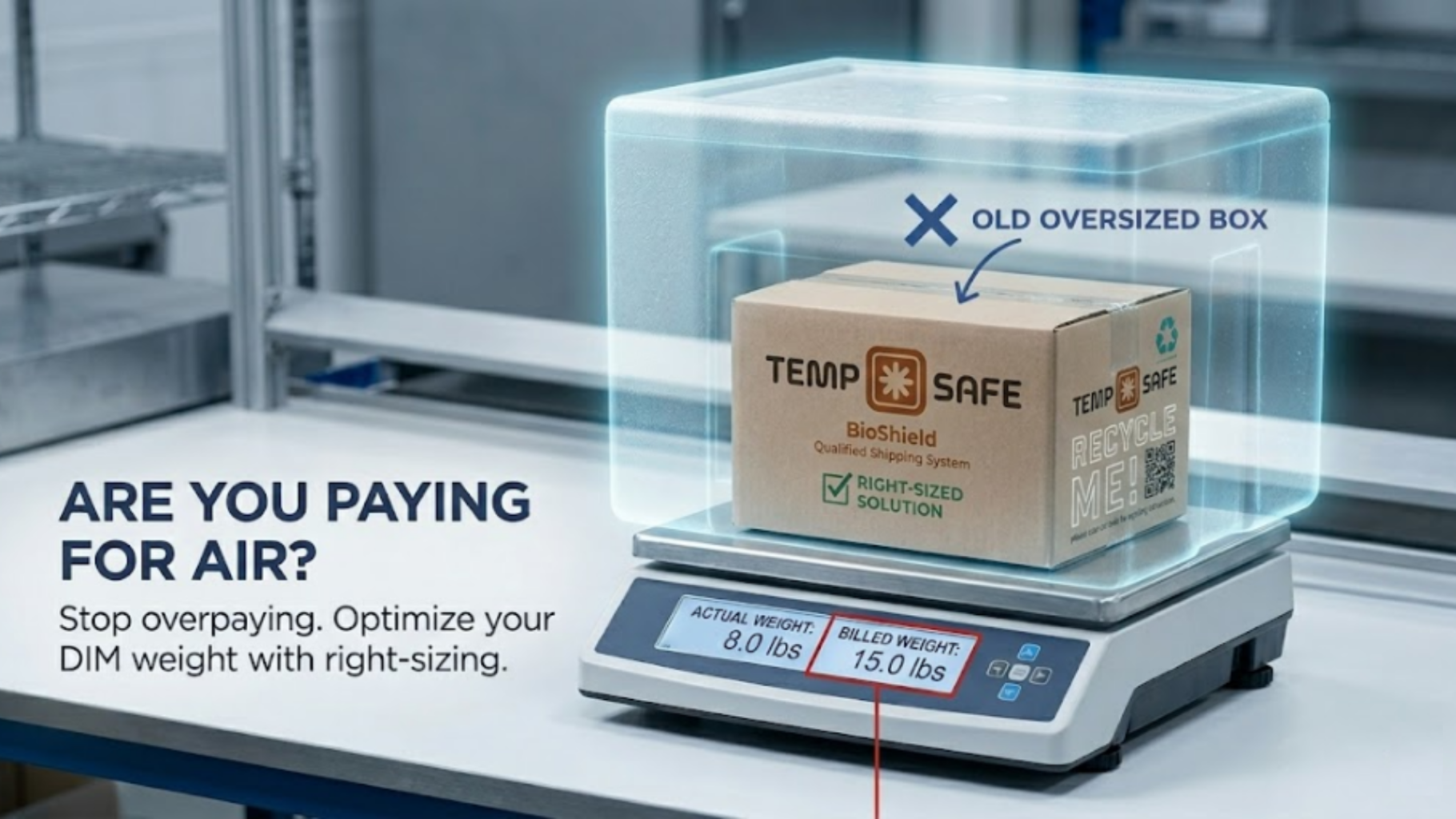
In cold chain, protection is everything. But there’s a fine line between “safely insulated” and “costly over-engineering.” If your dimensional (DIM) weight is consistently higher than your actual package weight, you aren’t just paying for the product, you’re paying a premium for empty space.
Use this checklist to see if your current solution is ballooning your freight spend. Download our Dim Weight Savings Calculator to see your potential impact.
1. The “Air Gap” Audit
Is there more empty space than product in your box? If your payload box isn’t tight around your product, you’re paying to ship empty air. Worse, that extra air acts as a “heat sink,” requiring you to add even more coolant just to keep the empty space at the right temperature.
2. The Refrigerant Reality Check:
Are you adding extra gel packs just to “fill the space”? If you’re throwing in extra coolant to stop products from sliding around, or “hoping” it stays in range because the box is too big, you’re losing twice. You’re paying for the DIM weight of the big box and the actual weight of unnecessary gel packs. Plus, too much coolant in a large space increases your risk of freezing the product.
3. The “Standardization” Trap
Are you using a “one-size-fits-all” shipper for everything? Using one large box for every order might seem simple, but if 80% of your shipments could fit in a smaller profile, that “simplicity” is costing you thousands in annual freight surcharges. Real savings happen when you match the shipper to the payload. See how your current shipper profile compares to optimized alternatives.
4. The Excessive Wall Thickness
Is your insulation unnecessarily thick for short-duration lanes? While thick insulation is great for long hauls, using it for 24-hour shipments can needlessly inflate your box’s outer dimensions. If you can achieve the same thermal protection with a thinner, high-performance material, you can drop a full DIM tier and see immediate freight savings.
5. The Billed Weight Discrepancy
Does your carrier invoice show a “Billed Weight” much higher than your “Actual Weight”? This is the ultimate red flag. If your package weighs 8 lbs but you’re being billed for 15 lbs, you’re paying a “space tax.” Carriers optimize for truck density, if your box isn’t optimized, they’ll make you pay for the density you’re wasting.